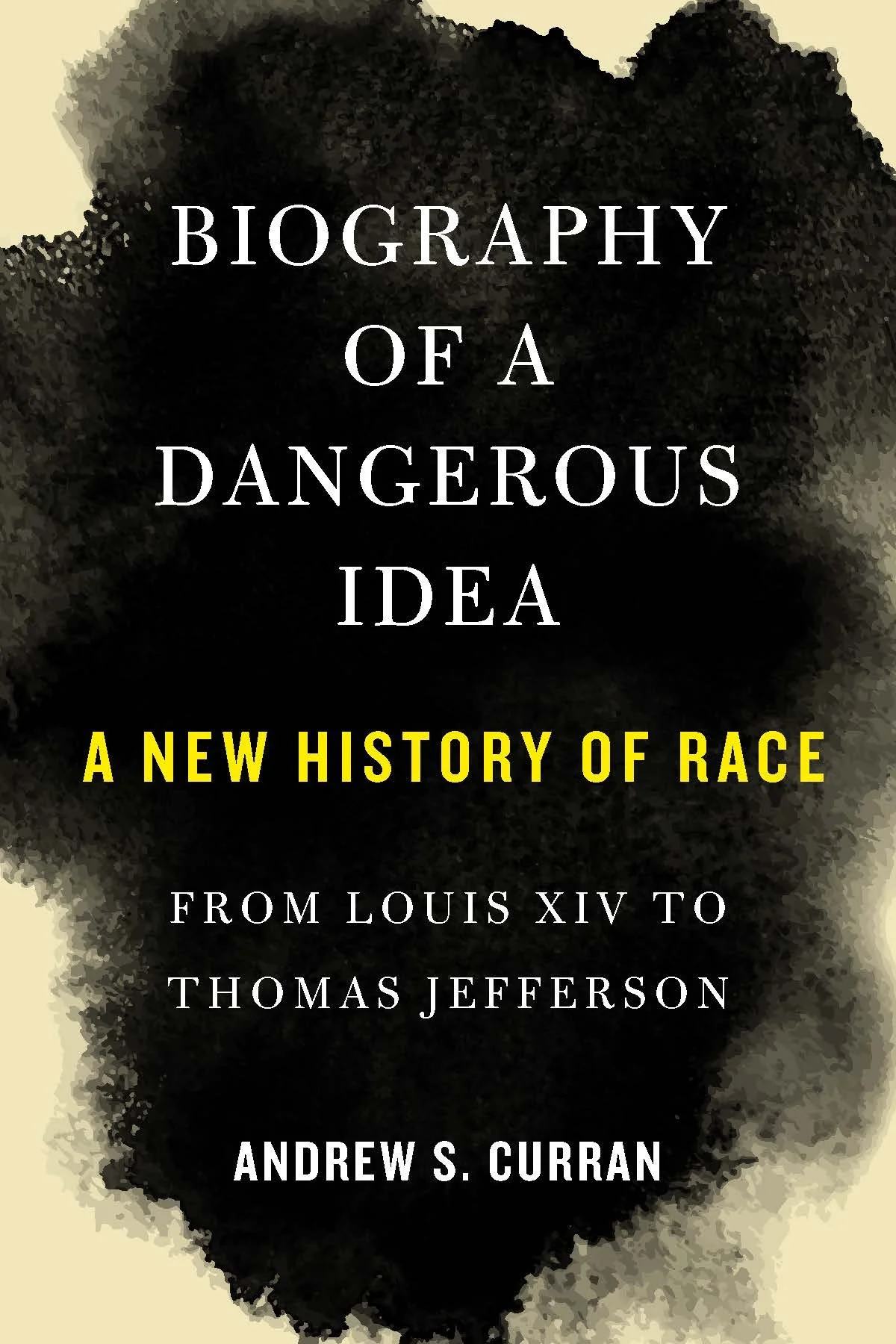
In Biography of a Dangerous Idea, Prize-winning biographer and historian Andrew S. Curran retraces the misunderstood history of the birth of race through the lives and ideas of thirteen pivotal figures. Moving from the gilded halls of Versailles to the slave plantations of the Caribbean, from the court of the Mughal Empire to the drawing rooms of Jefferson’s Monticello, this sweeping narrative reveals how the Enlightenment’s audacious quest for knowledge became entangled with systems of empire and oppression––while offering a bold new reassessment of the era’s most celebrated luminaries.
PRAISE

“Brilliant…a thorough and eminently readable dissection of a pernicious lie.”
— Publisher’s Weekly (starred review)
“A fascinating reassessment of that heady era of Western philosophy: how its towering thinkers came to invent the very idea of race as we know it today, and how that biological balkanization of humanity came to be passed down, quite misleadingly, as some sort of eternal truth.”
—NPR
“A top-shelf work of creative nonfiction and history, featuring clear and engaging narrative writing…A rewarding read that is essential for academic and high school libraries, classrooms, and public libraries’ biography and history collections.”
— Library Journal (starred review)
“Curran [exposes and critiques the Enlightenment’s dark side] with great style in this accessible, engaging, and illuminating history.”
—Irish Times
“Subtle and learned…a fluid and elegant narrative.”
—Times Literary Supplement
“A wide-ranging study of the development of the idea that there is more than one human race…A useful addition to the history of race and racism.”
—Kirkus Reviews
“The story of an idea as dangerous as race is one that few are brave enough to tell. In thirteen sparkling biographical cameos, Andrew Curran—sharp-eyed intellectual historian and large-hearted storyteller takes us on a journey to the dark side of the Enlightenment.”
— Janice P. Nimura, Author of The Doctors Blackwell, Pulitzer Prize Finalist
“Biography of a Dangerous Idea further cements Andrew S. Curran as one of our greatest scholars of the terrible history of race. A “vitally important, beautifully crafted book.”
— Henry Louis Gates, Jr. Author of The Black Box: Writing The Race
“In this immensely informative and highly readable [book], Curran demonstrates that ideas cannot be understood apart from the people who produced them. This is intellectual biography performed at the very highest level.”
—Maurice Samuels, Betty Jane Anlyan Professor of French at Yale University and Author of Alfred Dreyfus: The Man at the Center of the Affair
“Biography of a Dangerous Idea . . . is an invaluable work because, in showing us how race was made, it also demonstrates how this most dangerous idea can be unmade.”
— Evelyn M. Hammonds, Co-Author of The Nature of Difference: Sciences Of Race in the United States from Jefferson To Genomics
“Cleverly crafted and well executed. [The book] is sweeping, it is stunning, and hard to put down.”
— Rana A. Hogarth, Author of Medicalizing Blackness: Making Racial Difference In The Atlantic World, 1780–1840
“Andrew Curran, one of the foremost authorities on this subject, offers a necessary and illuminating exploration of eighteenth-century debates on race. . . A clear-eyed book that challenges caricatures on all sides.”
— Antoine Lilti, Author of The Legacy of the Enlightment: Ambivalences of Modernity
“As wonderfully accessible as it is meticulously researched. . . The book is a true gift for readers who seek to understand this complicated story.”
—Robert Bernasconi, author of The Critical Philosophy of Race
“Andrew Curran goes beyond the world of disembodied ideas, delving into the lives of the flesh-and-blood men whose actions and writings forged modern racial thought [T]his first and much-needed biographical history of race reveals the Enlightenment’s deepest contradictions and enduring legacies.”
— Silvia Sebastiani, Co-Author of Race Et Histoire Dans Les Sociétés Occidentales
“A multifaceted history of the idea of race. The portrait of each actor in that history is at once critical, nuanced, and humanizing. The book draws you in with exceptionally lucid and deft storytelling, and gently nudges you to think deeply about the questions raised by the stories. It is a unique and necessary contribution to the understanding of ‘race.’”
—Huaping Lu-Adler, author of Kant, Race, and Racism: Views from Somewhere