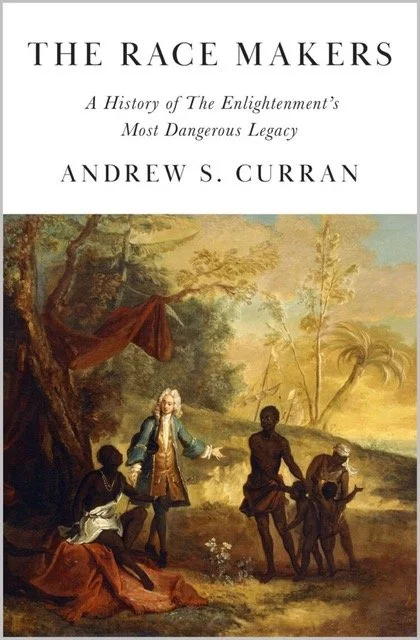
An engaging investigation of how thirteen key Enlightenment figures shaped the concept of race, from the acclaimed author of Diderot and the Art of Thinking Freely.
Over the course of the eighteenth century, Enlightenment natural historians and classifiers redefined what it meant to be human. By 1800, they had recast the very idea of humankind, sorting the world’s peoples into rigid biological categories for the first time in history. Prize-winning biographer Andrew S. Curran retraces this often-misunderstood story by plunging into the lives and ideas of the most influential individuals behind this reconceptualization, among them Louis XIV, Voltaire, David Hume, Immanuel Kant, and Thomas Jefferson.
Moving from the gilded halls of Versailles to the slave plantations of the Caribbean, from the court of the Mughal Empire to the drawing rooms of Monticello, Biography of a Dangerous Idea not only reveals the Enlightenment’s entanglement with empire and oppression—it offers a bold reassessment of the era’s most celebrated luminaries.
PRAISE

“Brilliant…a thorough and eminently readable dissection of a pernicious lie.”
—Publishers Weekly (starred review)
“Subtle and learned…a fluid and elegant narrative.”
—Times Literary Supplement
“Curran [exposes and critiques the Enlightenment’s dark side] with great style in this accessible, engaging, and illuminating history.”
—Irish Times
“A fascinating reassessment of that heady era of Western philosophy: how its towering thinkers came to invent the very idea of race as we know it today, and how that biological balkanization of humanity came to be passed down, quite misleadingly, as some sort of eternal truth.”
—NPR
“A top-shelf work of creative nonfiction and history, featuring clear and engaging narrative writing…A rewarding read that is essential for academic and high school libraries, classrooms, and public libraries’ biography and history collections.”
—Library Journal (starred review)
“A wide-ranging study of the development of the idea that there is more than one human race…A useful addition to the history of race and racism.”
—Kirkus Reviews